
panthrondev@gmail.com
09:09:03 September 3, 2026
When you sign up for the Umrah, the first decision you have to make is your hotel tier. Many people automatically assume that a higher star rating means a better travel experience, but this is far from true—a higher star count does not guarantee that your entire trip will go smoothly and suit your needs. Star ratings will not only substantially increase your total spending, but also determine how far you have to walk every day, how spacious your room can be, and even shape your overall accommodation experience. To put it simply, choosing a high-star hotel does not necessarily come with a more convenient itinerary; instead, it may lead you to waste a lot of unnecessary money. But if you choose a lower tier, you might end up uncomfortable during your stay, adding unnecessary hassle and disrupting what should have been a steady trip. You have to learn how to sort through these factors to pick the option that is best for you.
Hotel star ratings in Makkah and Madinah are different from those in ordinary resort cities. When you choose a hotel in other cities, star ratings might relate to varied amenities like whether there is a swimming pool or if SPA services are available, but in these two cities, there are only two core differences between different star ratings, with no extra flashy distinctions.
The first is the distance to Haram and Masjid. The Haram and Masjid referenced here are Makkah’s Masjid al-Haram and Madinah’s Masjid an-Nabawi, the core sites that everyone visiting the area attends for prayers every day. Most higher-star hotels are closer to these two sacred sites—not all, just most—so you walk less, avoid making long treks for daily prayers, and save the energy you would spend commuting.
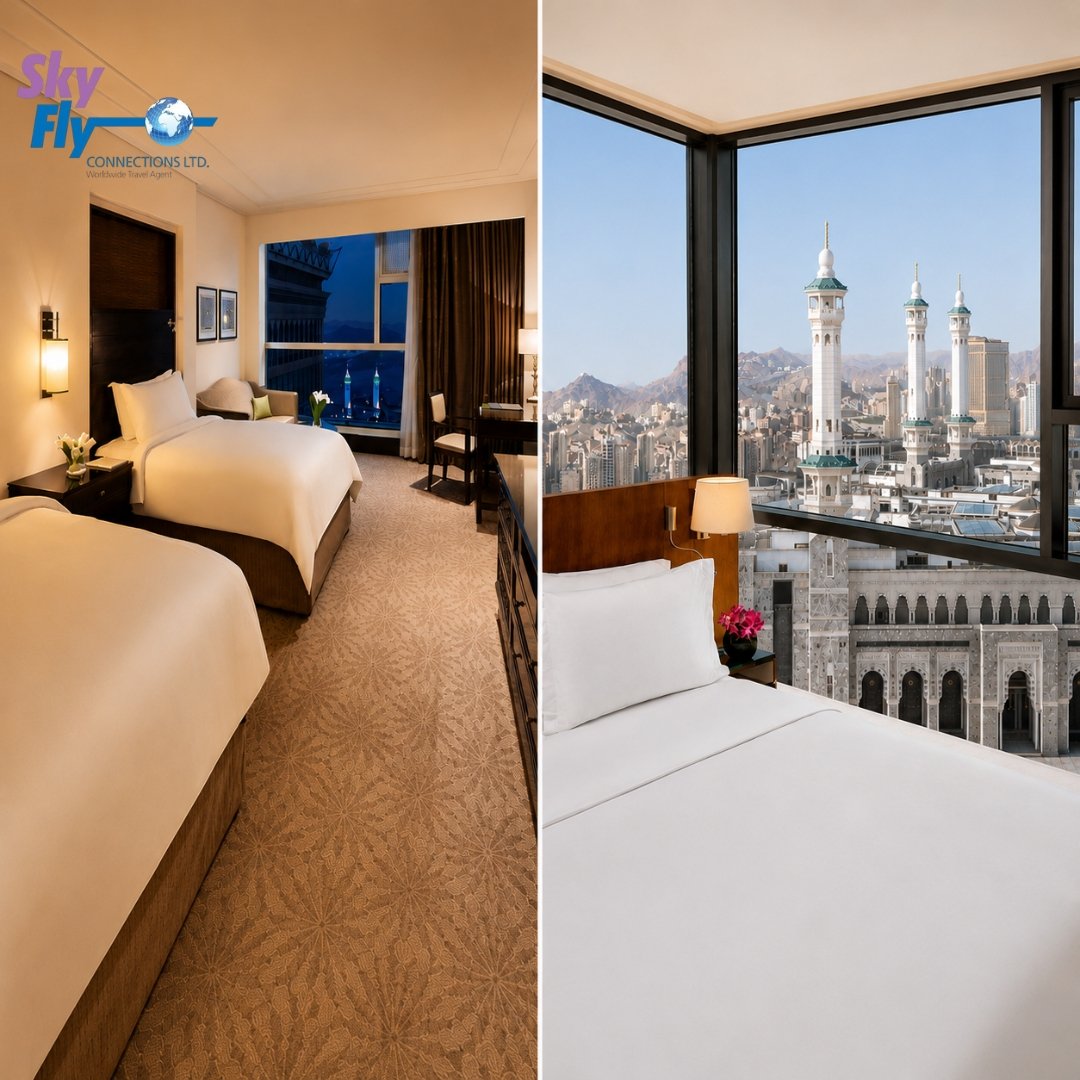
The second is the comfort and size of the room. 5-star hotels usually have more spacious rooms that do not feel cramped, with higher-quality bedding that lets you rest and sleep soundly. Core daily-use amenities like air conditioning and elevators are also more reliable, rarely breaking down, so you will not run into frustrating problems like your AC shutting down in the middle of summer or waiting half an hour for an elevator to arrive.
The second is the comfort and size of the room. 5-star hotels usually have more spacious rooms that do not feel cramped, with higher-quality bedding that lets you rest and sleep soundly. Core daily-use amenities like air conditioning and elevators are also more reliable, rarely breaking down, so you will not run into frustrating problems like your AC shutting down in the middle of summer or waiting half an hour for an elevator to arrive.
However, one thing to note: a high star rating does not guarantee you will be assigned a room with a view of the Haram and Masjid. Most hotels, regardless of the star rating you book, follow a uniform set of rules to assign rooms randomly. Just because you paid more for a high-star hotel does not mean you will be prioritized for a room with a good view. If you care deeply about being able to see the Haram and Masjid, you must ask this question directly and clearly. Do not assume that spending extra on a high-star hotel will automatically get you a view room, only to arrive with high expectations and be disappointed.
3-star Umrah packages are the most budget-conscious and practical tier of all available options. If you are going on the pilgrimage with your full focus on completing the required rituals, not seeking luxury hotel amenities, this tier will still keep you perfectly comfortable.
If you choose this tier, you should first prepare for these factors:
This tier is perfectly suited for three types of pilgrims: those who want to strictly control their spending and do not want to overspend on accommodation; those who are in good physical condition and have no problem walking extra distances; or those who only care about smoothly reaching Makkah and Madinah to complete their pilgrimage, and do not care at all if their hotel is luxurious.
Whether you are a first-time pilgrim or a returning veteran who has made the trip multiple times, 4-star accommodation is the optimal choice that hits every single one of your needs—it is convenient, reliable, and offers unmatched value for money. Even if you spend a little extra, it is absolutely worth it. It consistently delivers three core benefits, each of which justifies the small price difference:
Compared to 3-star accommodation, the walk to the mosque is far shorter, so you will not have to deal with the hassle of long commutes that come with the 3-star tier, and you can spend the saved time and energy on the core work of your pilgrimage.
Room quality and hotel facilities are far more reliable than lower-tier hotels, with very few issues. You will not run into frustrating problems like a sudden air conditioning breakdown or long waits for elevators, so you can rest comfortably every day after returning from the mosque.
The extra amount you spend is small, but the convenience of walking less is very tangible. Especially for older travelers, or those traveling with young children, this expense is more than worth it—you will not have to push through fatigue to make long walks, or carry young children while squeezing onto shuttle buses. The ease of the entire trip far outweighs the small additional cost.
5-star packages have the highest price of all tiers, but they deliver the maximum level of comfort and convenience. Most are the closest options to the Haram and Masjid for walking, so you avoid the hassle of long detours. Rooms are more spacious and do not feel cramped, and all facilities across the hotel are high-end, making your stay stress-free and easy. Most people who choose this tier fall into these categories:
Before you book, you must get clear, unambiguous answers to these key questions to avoid hidden risks. First, ask for the exact distance in meters from the hotel to the Haram and Masjid, and how long it would take an average person to walk that distance. Do not settle for a vague line like “it is very close”—empty descriptions cannot help you judge the actual travel burden you will face. Next, ask if your booked package includes a shuttle bus service? If it does, how often does the shuttle run? These details directly impact whether your commuting arrangements will run into trouble. Also ask: what is the listed maximum occupancy for your room? Will you need to share the room with other guests? Can that occupancy standard be guaranteed after your booking is confirmed? Do not wait until you arrive to find out that things do not match your expectations, which will disrupt your itinerary. Finally, ask clearly: does the price difference between different booking tiers only apply to the hotel stay itself? Or will included services like airfare and ground transfers also change? You must have a clear understanding of exactly what your money is paying for.
When choosing a hotel, many people easily fixate only on cost, assuming it is simply a matter of whether their budget is enough or if they are willing to spend extra, but that is not the case. The walking distance from your hotel to the Haram and Masjid will tangibly impact your entire travel experience, and that impact cannot be offset by saving a small amount of money. This impact becomes even more pronounced if you are traveling with elderly parents or young children—elderly people have limited mobility, and their legs and feet will ache after walking for too long, while young children have limited stamina and will quickly get tired and ask to be carried, forcing you to spend all your energy caring for them instead of being able to focus on preparing for prayers. That is not to mention if you travel to Makkah in summer, when the local weather is extremely hot. Walking even one extra step under the blazing sun is a hardship; sweltering heat wraps around you, and you will be sweating profusely and out of breath after only a short walk, putting you at high risk of heatstroke and discomfort. This commute stress takes a huge toll on your entire trip. Instead of choosing a cheaper hotel to save money, it is far better to spend the small extra amount to book a slightly higher-tier hotel that cuts 25 minutes off your daily walk. If you make five round trips to the Haram and Masjid every day, that adds up to avoiding more than two hours of unnecessary walking. That small extra expense is far more worthwhile than its price tag suggests. If you stay in Makkah for a week or longer, and attend prayers every day, the cumulative ease you gain from this daily savings becomes even more significant.
There is never a one-size-fits-all “standard answer”—there is only the choice that aligns with your own situation, budget, and the needs of your travel companions. Choosing a hotel star rating is never a matter of picking whatever someone else says is good; you have to first clarify all your own actual circumstances before making a decision.
You have to realistically figure out how much walking you, and everyone traveling with you, can actually handle. Do not push yourself to claim you can walk long distances, and do not overestimate the stamina of any elderly or young children in your group. If you end up struggling with the daily commute once you arrive, you will only create problems for yourself.


WhatsApp us