
panthrondev@gmail.com
09:09:03 September 3, 2026
For many British Muslims, Umrah and Hajj are not the end of their explorations, but rather a stepping stone. After completing these two core religious journeys, they often develop a stronger interest to delve deeper into Islamic history and cultural heritage. They do not stop their explorations after returning home; instead, they wish to travel across more lands tied to Islamic civilization and engage with far-reaching pasts. Beyond the two holy cities that host these two journeys, a vast network of sites across the Muslim world each bear profound religious and historical significance, well worth a dedicated trip to visit. What follows are some of the most prominent of these sites.
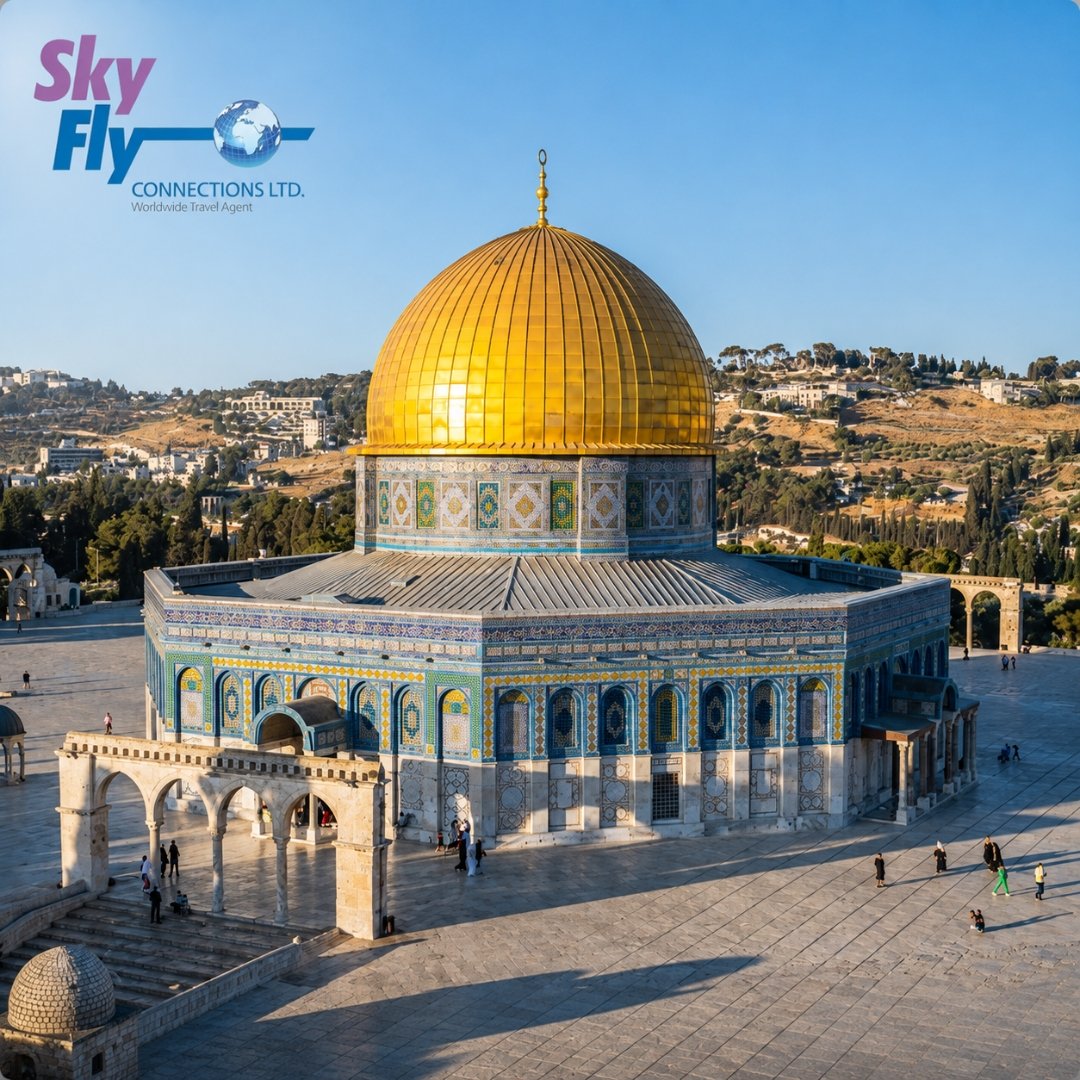
Jerusalem holds a unique status in Islamic tradition; it is the location where Prophet Muhammad’s Isra and Mi’raj, his Night Journey and Ascension, took place. On this land of special religious significance stands Al-Aqsa Mosque, the third-holiest site in Islam. Alongside the well-known Dome of the Rock, it forms part of a larger sacred religious compound. The golden dome of the Dome of the Rock is visible from afar, its walls adorned with intricately assembled tilework, making the structure so striking that anyone approaching can identify it immediately.
The experience of Visiting Jerusalem is completely different from that of visiting Makkah and Madinah. Jerusalem’s Old City has stood on this land for thousands of years; every brick and every street is layered with intertwined histories, and walking through its alleys feels like stepping onto a long scroll inscribed with millennia of stories. Many pilgrims who travel here specifically say that the sense of humility this trip brings is entirely unlike the experience of visiting the other two holy cities. As they wander slowly through the Old City’s narrow lanes, brush past passersby, and finally come face-to-face with the familiar sacred site, before entering Al-Aqsa Mosque to complete their prayers, many never expect to be so deeply moved.
Karbala, located in present-day Iraq, derives its profound significance from the historical event of the Battle of Karbala and the holy shrine of Imam Hussain. For all who travel here, this is no ordinary trip. Most pilgrims who make the dedicated journey come seeking a space to reflect quietly, to sort through their thoughts in this holy city that holds centuries of religious memory. Visitors arrive throughout the year, with crowds swelling especially during important commemorative dates marked in the Islamic calendar, as the entire city is immersed in a solemn pilgrimage atmosphere.
Nearby Najaf is home to the Tomb of Imam Ali. Many travelers include both sites in a single itinerary, allowing them to visit these two extraordinarily significant holy sites in one trip, rather than making separate journeys for each.
The mindset behind this trip is very different from that of undertaking the minor pilgrimage. It is rooted in quiet reflection, and often leaves visitors deeply moved. Those who have made the journey all say that this trip complements, and never replaces, the Hajj or Umrah. It cannot substitute the meaning of completing those two core religious rituals in Makkah, but it adds a richer historical layer to the original pilgrimage experience, making the entire pilgrimage journey more complete.
Even when staying in the holy city of Makkah, your itinerary should not revolve solely around the Great Mosque; there are many other sites worth a dedicated visit. Hira Cave, located on Mount Jabal al-Nour, is the place where Prophet Muhammadﷺ first received divine revelation. If you are physically able, you can attempt to climb up to it—the mountain path is quite steep, and the walk is not easy, but every step carries special weight. Visiting this cave is not a core required ritual of the Makkah pilgrimage; no one mandates that you must go, but for many dedicated pilgrims, the moment they stand inside that cave becomes the most unforgettable and personally important stop of their entire trip.
Quba Mosque, located on the outskirts of Madinah, is the first mosque built in Islamic history. It was personally overseen by Prophet Muhammad when he arrived in Madinah from Makkah. Most guided Madinah travel itineraries include this mosque alongside other local historical sites on the same route, setting aside dedicated time to visit it, rather than treating it as an optional afterthought. This serves as a reminder that Madinah’s value extends far beyond the famous Prophet’s Mosque that welcomes the vast majority of pilgrims; this holy city is home to many other sites that carry the weight of early Islamic history, all worth pausing to explore properly.
Not all meaningful itineraries need to revolve around religious holy sites. It is common for trips to the Islamic world to focus on widely recognized core religious locations, but a meaningful journey does not have to be rigidly planned to only visit sacred sites. A trip to Pakistan is different: visitors can immerse themselves in local life and culture, while also exploring this country rooted in South Asian Islamic traditions—viewing historical buildings that bear the marks of time, sampling unique local cuisines from across the region, and traveling through its vast, sprawling mountains and rivers. For many British Pakistanis, this trip is far more than ordinary sightseeing; it is tied to their family’s past, and to their identity of “who I am”. Many British-born Pakistanis have only ever heard fragmentary stories of their ancestral homeland from their families while growing up; this return trip is not a stop to take a few tourist photos before leaving, but a process of grounding a sense of identity that once felt adrift, by walking on the land their ancestors called home.
If you plan to add these extra destinations to your itinerary, it is best to share this idea clearly with your booked travel agency at the very start of the planning process.
These types of combined itineraries that stitch together multiple routes—such as combining an Umrah trip with a stay in Jerusalem, or linking visits to Karbala and Najaf—cannot follow the standardProcess of a regular Hajj or Umrah itinerary. They require advance handling of different visa requirements, coordination of flight routes that accommodate cross-city travel, and selection of a suitable travel season to avoid various risks; every requirement differs from that of a standalone standard pilgrimage trip.
You must choose a travel agency experienced in organizing multi-destination itineraries, one that has successfully planned many of these cross-city combined trips. Only a professional agency of this kind can advise you on which combinations are logistically feasible, rather than promising unworkable plans, and can help you select the most suitable travel dates to smooth out the rhythm of your entire journey.
Whether you schedule visits to these sites alongside your Hajj and Umrah in a single trip, or plan to travel to them separately at another point in your life, this experience will only deepen the spiritual weight of your pilgrimage, never dilute it. These extra sites, which fall outside the core pilgrimage itinerary, all hold threads of early Islamic history. When you stand on the land where these stories actually unfolded, all the narratives you have heard since childhood cease to be distant legends from books or your elders’ accounts. Whether it is the cave on the outskirts of Makkah, the mosque in Madinah, the religious compound in Jerusalem, or the holy shrine in Karbala, every step you take and every scene you witness fills in the once-vague background of these stories. The familiar narratives you have grown up with take root and solidify in the physical spaces where they originally occurred, transforming into real scenes you have touched, walked through, and witnessed with your own eyes.


WhatsApp us